






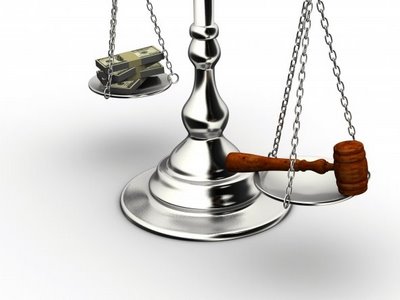
 Corruption is well known to be a problem of society. Most complaints about corruption center around the illegitimate amassing of wealth by elites who use public office and public resources for their own personal gain. By reducing the amount of money available for public improvements, corruption of this sort does great harm to the country. They other type of corruption that is most often discussed is the practice of favouritism and nepotism by those in power, another way that the nation’s wealth is amassed by the powerful few and their friends. But it is not only these acts themselves that harm the national interest. The mere appearance of corruption is, in itself, enough to cause great harm and should also be avoided.
Avoiding the appearance of corruption is equally important to avoiding actual acts of corruption because even the mere appearance of corruption is enough to have a negative effect on the people’s faith in their national institutions. When people believe an institution is corrupt, every decision taken will be done under a cloud of suspicion, not matter whether it was legitimate or not.
Let us take a recent example as a demonstration.
National Accountability Bureau appealed to Supreme Court on Wednesday seeking recovery of property held by Nawaz and Shahbaz Sharif that is attached to Hudabiya corruption scandal. The court rejected the appeal saying “NAB has no authority to recover the property and, therefore, we see no force in this case. Dismissed.”
The next day, the Supreme Court heard arguments related to another corruption case – one involving the President Zardari. In this case, the PM was asked to explain why he has not written a letter to Swiss authorities requesting that corruption cases be reinstated against Zardari. The PM explained that he had not ordered the letter because the president enjoys constitutional immunity while he is in office, so he has no authority to do so. Meanwhile, the Swiss themselves have said also that the cases cannot be revived, even if Pakistan asks for it. According to the Swiss chief prosecutor Daniel Zappelli, he has “no evidence” to bring Zardari to trial. So the Supreme Court also dismissed the case against Zardari for the same reason they dismissed the case against the Sharifs, right?
Wrong.
In the case against Zardari, even though the constitution clearly says the president has immunity, the judges began speculating that maybe they would not honour the constitution’s clear words and ordered the PM’s attorney Aitzaz Ahsan to prepare an argument convincing them. Ahsan then requested one month to prepare his case, and the court told him he had less than two weeks. Justice Khosa thought he should be given one day.
Why one case before the Supreme Court is treated so much differently than another? It is hard not to view the two cases in the context of the recent personal history of the main characters. When Asif Zardari was elected as president, he was slow to reinstate Iftikhar Chaudhry as chief justice. Nawaz Sharif came to Iftikhar’s rescue by organising a long march in support of the Chief Justice. Even though it was Zardari who actually reinstated the Chief Justice, many believe that he continues to hold a grudge against the president for not acting immediately.
Even Mansoor Ijaz, on whose word the Supreme Court has formed a judicial commission to investigate the memo case, has said that the Chief Justice “owes” Nawaz Sharif.
Is this the case? Is the Supreme Court infected with the same corruption as the institutions that they are supposed to be judging? Is there one rule of law for the Chief Justice’s friends, and another, harsher law for those who he doesn’t like? Of course we can’t know what the justices’ true motivations are. But it doesn’t matter. The fact is, it looks bad. Whether the court is acting arbitrarily or not, it has the appearance of injustice. And this appearance is harming the faith of the people in the independence of the judiciary.
So what is the solution? How do we move beyond this mess? One option is called ‘recusal’. Justices who have personal history with those involved in the cases can voluntarily step aside for those cases and allow a neutral judge to sit in their place. This regularly happens in courts all over the world, and is seen as a shining example of the honesty and integrity of the judges who voluntarily recuse themselves from cases in which, even if they have no intention of acting inappropriately, there is a possibility that their involvement could give the appearance of being unjust.
A judiciary is an institution, not an individual. When the two become mixed up, then the appearance of individual corruption can have a devastating impact on the ability of the institution to be accepted as independent. And once a court has lost the faith of the people, it is very hard to regain.

This is my story against corruption what i did for govt.of Pakistan and what i get in return ???
please check out the links below:
http://www.youtube.com/watch?v=vorrCgivmy0
http://tribune.com.pk/story/335672/exposing-graft-14-years-on-informant-awaits-just-reward/
http://tribune.com.pk/story/345623/informant-still-awaits-reward-justice-must-be-dispensed-for-schon-whistleblower/
Transparency International- only showing dirty face of Pakistan…..
I, Aamir Ahsan Khan, who became the major source of Information & credible evidence for use of the Chairman of Ehtasab Bureau, and existing National Accountability Bureau (NAB) and played a pivotal role in assisting Government organization to recover Rs 3 Billion from the Schon Group is running from pillar to post since the last fourteen years to get my national award, Tamgha-e-Imtiaz and 10 percent reward money as promised by the government, according to the relevant rules in force.
I was working as a Senior Manager Maintenance with the Schon Group in 1997 when I was pressurized to sign bogus bills of Rs 640 million. However, instead of signing those bills I approached Saif-ur-Rehman and the then Joint Secretary Mr.Hassan Waseem Afzal of the then Ehtasab Bureau and exposed the whole Schon Group scam.
According to the intensive “Transparency” policy of the Government of Pakistan at that time, and according to the Ehtasab / NAB ordinance 1999, Paragraph 33A.I, Aamir Ahsan Khan the (sole informer) was supposed to be paid the (widely publicised) reward money of 10% of the recovered amount, I have been paid nothing after lapsed of 14 years.
The then Prime Minister Mian Nawaz Sharif had a telephonic conversation with me and had personally seen my application and marked it to the Chairman Ehtasab Bureau for the release of my 10% reward and nominated me for National Award ‘’Tamgha-e-Imtaz.’’
Documents available with “Me” are the proof that after exposing the corruption of Schon Group, I wrote numerous letters and had personal audience with the concerned officials of the then Ehtasab Bureau and NAB, Mr. Hassan Waseem Afzal, Mr.Shahid Hassan Raja, Mr. Talat Ghumman, Mr. Aamir Aziz , Col. Iftaqar Rasool, Mr.Kausar Iqbal Malik and Mr. Khawar Hussan including its Chairmen Mr. Saifur Rehman, Lt. Gen. Muhammad Amjad, Lt. Khalid Maqbool, Lt. Muneer Hafeez, Lt. Gen. (R) Shahid Aziz, Mr. Naveed Ahsan, Justice (R) Dedaar Hussain Shah and Deputy Chairman Mr. Javid Zia Qazi and present DG Bragadier Hadeed Anware Malik. Every-time it was assured that my case will be dealt on priority basis after total recoveries were made. NAB itself, had also announced reward money for those who would expose corruption, but how many have received this prize money is a question yet to be answered?
In the tenure of President Musharaf, Chairman Naved Ahsan marked my case to the ousted DG NAB Kausar Iqbal, who deliberately delayed it for six years by criminal manipulation and malafide intentions: since Mr. Kausar was a tool for Schon Group for the settlement of their bank defaulted loans by doing Dubai Agreement.. An enquiry can reveal many hidden stories which took place in the corridors of NAB during his 6 years of office. This strengthens the claim that justice has been deliberately delayed and exploited for ulterior motives of people in authority.
After knocking all doors, I am left with no option but to seek Justice from Mr. Iftiqar Muhammad Chaudhry, for taking SUO MOTTO Action. This is the only option left to seek Justice in Pakistan, as Justice delayed is Justice denied.
Needless to say, that it should be correct to expect institutions which are established to perform a specific function to deliver their services in a timely and responsible manner, without a third party intervention, should actually do so. I mockery. want to clear it that I have no lust for money and if ever I got this reward I will form a Trust for underprivileged seeking Justice. Hence, Supreme Court & NAB must act, or else Justice in our country will become a political
Transparency International an organization that is foremost associated with global efforts against corruption and financial misappropriation has been an absolute source of dismay and disillusionment for me, Aamir Ahsan Khan. Needless to say this letter is a reflection of my angst and complete disappointment with the way in which my appeal and efforts have been addressed by your so-called watchdog agency in Pakistan.
In order to make my claim stronger and worthy of your time I would merely like to point out something that I read on your website and that is inevitably linked to my fury against the way my issues have been dealt with in terms of support and guidance. I believe it is rightly said on your website regarding the corruption scenario in Pakistan that the primary root of all such issues is Lack of accountability – “The most important cause of local government corruption in Pakistan, according to Pakistanis, is a ‘lack of accountability’: comprising 20.76% of total responses given to the question ‘In your opinion, what factors are responsible for corruption in the local government system?’. Lack of transparency (15.1% of responses) and low salaries (14.56% of responses) are the next most cited reasons (‘National Corruption Perceptions Survey’, Transparency International Pakistan, 1st July 2010)”.
I have been victimized for 14 years by this lack of accountability and is it not your prime responsibility to be my backbone, if I seek your esteemed organization with solid proof to bring my brave and dauntless efforts into the limelight, solely for being an anti-corruption contributor in Pakistan.
Just to provide a brief overview of the source of conflict I am involved in with regards to the operationalization of procedures within Transparency International I would like to Insert my correspondence details with your organization. I have had the following written communication with your team:
1) 23-02-2012-Letter to Mr. Saad Rashid. TI, Pakistan
2) 31-12-2011- Letter from Mr.Saad Rashid. TI, Pakistan
3) 29-12-2011-Letter to Ms. Georgia TI, TI Berlin
4) 29-12-2011-Letter from Ms. Maria Mudassir. TI, Pakistan
5) 29-12-2012-Response to Ms. Maria Mudassir. TI, Pakistan
This is quite a pity that irrespective of such regular communication, my appeal has been turned down and given the most blatant refusal in terms of help stating that Transparency International does not investigate cases, or judge corruption through independent research( Reference to Mr. Saad Rashid’s letter delivered to me on 31st December 2011).None of your team members have been fore-sighted enough to realize that I never sought legal action from the organization, but knowing that TI is a watchdog organization, I initiated this correspondence expecting some form of lobbying which could culminate in the establishment of a precedent for anti-corruption initiatives in Pakistan. I feel it is an absolute lack of civic and moral responsibility to deny support for a cause your organization widely publicizes.
My question remains the same: Is Transparency International operating in Pakistan to highlight the woes and miseries faced by Pakistanis, or merely to wash our dirty linen in Public. Can you not provide me with a set of guidelines to pave a consistent route to justice as far as my case is concerned? I would assume that is your undertaking and responsibility. Can you not appraise me for my efforts and endless wait for 14 years to receive delayed justice and denied rights? I urge you to understand and empathize with me; I am in need of recognition for our elitist authorities are lost in the delusional corridors of power and wealth.
I made a very sincere effort to highlight my case details honestly and continued to send press publications of my case, but it seems that for TI an individual’s efforts to annihilate corruption means nothing more than a personal choice. For me it marked my patriotism and compassion for those who suffered at the cost of this corruption by a private sector institution. I urge you to take action or else my faith in selflessly motivated organizations like yours will be shaken forever.
AAMIR AHSAN KHAN
Cell: 03009233927
Off: 02135423600
Email : [email protected]
A home-based banker with clout and privileges (KAUSAR IQBAL MALIK)
Umar Cheema THE NEWS
Saturday, September 24, 2011 ISLAMABAD: For those dreaming to excel in the banking sector, the story of Kausar Malik inspires confidence: a man who first manoeuvred his induction as Senior Executive Vice President (SEVP) in the National Bank of Pakistan (NBP), his house was also hired, a banking unit was shifted at the premises and he was then posted at his home.
http://www.thenews.com.pk/Todays-News-2-69213-A-home-based-banker-with-clout-and-privileges
Comments are closed.